Marketing has always been the backbone of every successful business. No matter how innovative a product or service is, it needs the right promotion to reach the right audience. Over time, the way businesses communicate with their customers has evolved significantly. What once relied entirely on offline methods has now shifted toward online platforms. This evolution has given rise to an important comparison between traditional marketing and digital marketing.
Understanding the difference between these two forms of marketing is essential for students, business owners, and professionals who want to grow in today’s competitive environment. Both approaches have their own strengths and limitations, and knowing how they work can help in making better decisions.
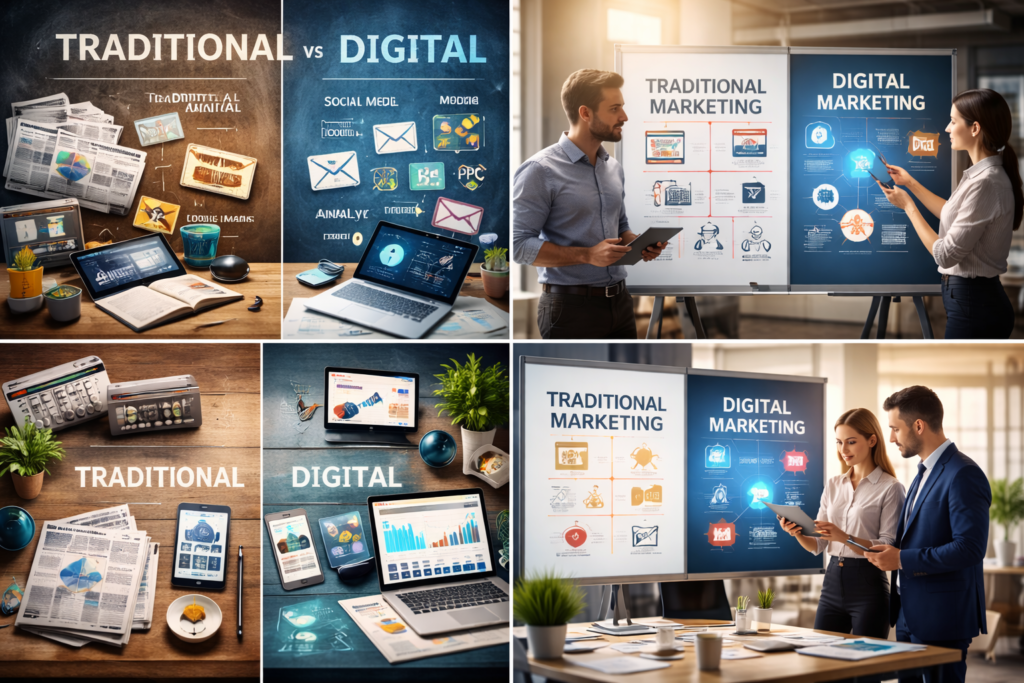
Traditional marketing refers to the conventional methods of promoting products and services that existed before the internet became widely accessible. These methods include television advertisements, radio promotions, newspaper ads, magazine placements, billboards, brochures, and direct mail campaigns. These channels have been used for decades and have played a major role in building many well known brands.
Digital marketing, on the other hand, is a modern approach that uses online platforms and digital technologies to promote products and services. It includes search engine optimization, social media marketing, content marketing, email campaigns, influencer collaborations, and online advertising. Digital marketing relies on the internet and digital devices such as smartphones, laptops, and tablets to connect with audiences.
One of the most noticeable differences between traditional marketing and digital marketing is the way they reach their audience. Traditional marketing generally targets a broad audience. For example, a television advertisement is shown to everyone watching a particular channel at a given time. While this can create awareness, it does not guarantee that the message is reaching the right people. Digital marketing, in contrast, allows businesses to target a very specific audience. Companies can define their audience based on age, gender, location, interests, online behavior, and even purchasing habits. This precision makes digital marketing more efficient and impactful.
Another important difference is cost. Traditional marketing methods are usually expensive. Running a television commercial or placing a full page advertisement in a popular newspaper requires a significant budget. Small businesses often struggle to afford such campaigns. Digital marketing, however, offers a more affordable alternative. Businesses can start with a small budget and still reach a large number of people. Platforms like search engines and social media allow advertisers to control their spending and adjust their campaigns according to performance.
Measuring results is another area where digital marketing has a clear advantage. In traditional marketing, it is difficult to track how effective a campaign is. For instance, if a company distributes flyers, it is hard to know how many people actually read them or took action. Digital marketing provides detailed analytics and insights. Businesses can track how many people saw an advertisement, clicked on it, visited a website, and completed a purchase. This level of data helps marketers understand what works and what needs improvement.
Flexibility is also a key difference. Traditional marketing campaigns are often fixed once they are launched. Making changes can be costly and time consuming. For example, if there is an error in a printed advertisement, correcting it requires reprinting and redistribution. Digital marketing offers much more flexibility. Campaigns can be modified in real time. Advertisements can be paused, edited, or optimized based on performance. This allows businesses to respond quickly to market changes.
Engagement with customers is another important factor. Traditional marketing is mostly one way communication. The business sends a message, and the audience receives it without much interaction. Digital marketing, however, enables two way communication. Customers can comment, share, like, and interact with brands directly. This creates a sense of connection and helps in building long term relationships.
Reach is another major difference between the two. Traditional marketing is often limited by geography. A local newspaper advertisement will only reach readers in a specific area. Digital marketing breaks these boundaries. With the internet, businesses can reach customers across different cities, countries, and even continents. This global reach opens up new opportunities for growth.
Speed is also a defining factor. Traditional marketing campaigns take time to plan and execute. Designing, printing, and distributing materials can take several days or weeks. Digital marketing campaigns can be launched almost instantly. Results can also be observed in real time, allowing businesses to make quick decisions.
Personalization is another area where digital marketing stands out. Traditional marketing delivers the same message to everyone. Digital marketing allows businesses to personalize their communication. Emails can be customized, advertisements can be tailored to individual preferences, and content can be designed based on user behavior. This increases the chances of engagement and conversion.
Despite the many advantages of digital marketing, traditional marketing still holds value. It is often considered more credible by certain audiences, especially those who are not very active online. A well placed billboard or a television advertisement can create strong brand recall. Traditional marketing is also effective for reaching local audiences and building trust in certain markets.
In today’s world, many businesses use a combination of both traditional and digital marketing. This integrated approach allows them to take advantage of the strengths of each method. For example, a company might use television advertisements to create awareness and digital campaigns to drive engagement and sales.
For students who are planning to build a career in marketing, understanding digital marketing has become essential. The demand for digital marketing professionals is increasing rapidly as more businesses move online. Learning these skills can open up a wide range of career opportunities.
This is where proper education and training become important. Global School Digital Marketing plays a significant role in preparing students for this evolving industry. The institute focuses on practical learning, ensuring that students not only understand the concepts but also know how to apply them in real situations.
At Global School Digital Marketing, students are trained in various aspects of digital marketing including search engine optimization, social media strategies, paid advertising, and content creation. They work on live projects that give them real world experience. This hands on approach helps students build confidence and develop the skills needed to succeed.
Another important aspect of learning digital marketing is staying updated with the latest trends. The industry is constantly changing, with new tools and technologies being introduced regularly. Global School Digital Marketing ensures that students are aware of these changes and are prepared to adapt.
From a business perspective, choosing between traditional marketing and digital marketing depends on several factors such as target audience, budget, and objectives. For large scale brand awareness, traditional marketing can be effective. For targeted campaigns and measurable results, digital marketing is often the better choice.
Small businesses and startups benefit greatly from digital marketing because it allows them to compete with larger companies without spending a huge amount of money. By using smart strategies, even a small business can reach a large audience and achieve significant growth.
The future of marketing is clearly leaning toward digital platforms. As internet usage continues to grow and technology becomes more advanced, digital marketing will play an even bigger role. However, this does not mean that traditional marketing will disappear. Instead, it will continue to exist alongside digital marketing, serving specific purposes.
To succeed in this evolving landscape, it is important to develop a balanced understanding of both traditional and digital marketing. While digital marketing offers more opportunities and flexibility, traditional marketing still provides value in certain situations.
For students and professionals, the key to success is continuous learning. Marketing is a field that changes rapidly, and staying updated is essential. Developing skills in digital marketing while understanding the basics of traditional marketing can create a strong foundation for a successful career.
Global School Digital Marketing helps students achieve this balance by providing comprehensive training and practical exposure. The institute prepares students not just for jobs but for long term growth in the industry.
In conclusion, traditional marketing and digital marketing are two different approaches with their own advantages and limitations. Traditional marketing is effective for mass communication and building brand credibility, while digital marketing offers targeted reach, cost efficiency, and measurable results.
Both methods have their place in the marketing world, but the growing importance of digital platforms makes digital marketing a crucial skill for the future. By learning and adapting to these changes, students and professionals can unlock new opportunities and build successful careers.
Choosing the right path and gaining the right knowledge can make a significant difference. With proper guidance and practical training from institutions like Global School Digital Marketing, anyone can develop the skills needed to succeed in the modern marketing landscape and take full advantage of the opportunities that the digital world offers.